What is a Service Advisor in a Car Dealership?
Understanding Their Role in Measuring Technician Performance
A service advisor in a car dealership is the communication hub of the service department. To start, they greet customers, listen to vehicle concerns, schedule appointments, and coordinate repair workflows to ensure timely completion. Additionally, they explain technical information, relay updates, and maintain a smooth connection between the customer and the technicians.
Service advisors may perform test drives to replicate symptoms and better understand customer issues. They also support the customer experience by handling billing, answering questions about charges, and ensuring all repair details are documented accurately. Furthermore, working closely with technicians, they prepare repair orders, confirm recommendations, and maintain clear communication throughout each job.
To succeed, service advisors need strong interpersonal and communication skills, plus basic computer proficiency, to manage customer information and service records. While a high school diploma is typically required, most advisors receive on-the-job training; others complete formal programs for additional technical expertise.
Required skills for this entry level position include strong interpersonal skills, strong communication, and basic computer skills for managing customer information, service records, and using specialized software. A high school diploma is typically required to become a service advisor in a car dealership, and most receive on-the-job training to enhance skills. Alternatively, some may complete a formal program to gain the necessary expertise.
A good service advisor in a car dealership blends technical knowledge with customer service expertise, handling customer complaints as a critical responsibility to ensure customer satisfaction. Service advisor skills such as organization, attention to detail, and the ability to multitask are essential for success in this fast-paced environment. Sales skills are critical for upselling services to customers while respecting their budget.
11 Steps to Measure and Predict Service Technician Performance
Your goal in evaluating technician performance is simple: build a month-by-month forecast of labor revenue, parts revenue, and gross profit for the coming year—accurately and efficiently.
Here’s the good news: recent technician performance is your best predictor of future performance.

What are the Categories of Work Mix in the Automotive Industry?
Before diving in, outline the five different categories of work. Each of these categories should be forecast independently and seen as different businesses.
- CP Competitive includes LOF or “the works” services that are nationally advertised and competitively priced.
- CP Maintenance includes routine services.
- CP Repairs are more complex, require a higher degree of skill, and often command a higher price in the marketplace.
- Warranty includes primarily work done for the OEM.
- Internal
These categories will be utilized throughout the process of establishing a baseline for each technician and their performance.
11 Steps to Establish a Technician’s Baseline Performance
Step 1: Find Labor Hours and Work Distribution
Start by reviewing the labor workbook for technician #1. From there, for every technician we’re looking at in any given month, we can find out from the information that’s available through the DMS, or through an analytics tool, how many hours were booked in that period of time, and that becomes the baseline. Taking a look at those hours for the month, we see how many hours were distributed across competitive, maintenance, repair, warranty, and internal work.
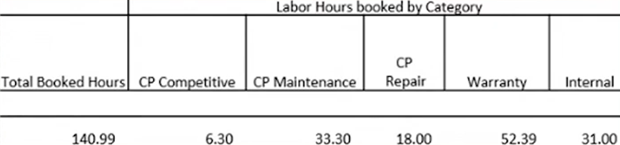
In this example, this technician is pretty well spread out in terms of the work being performed. However, in some shops, you might find that sometimes you’ll have quick lube only technicians where the majority of their work is competitive.
Once we know the total hours, divide the hours in each labor category by the total to get to a percentage. This example shows a well balanced technician.

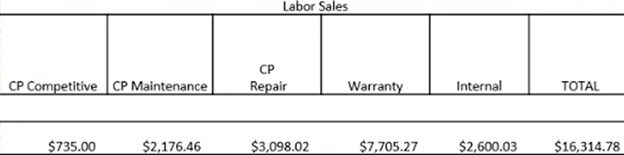
Step 2: Examine Labor Sales
Next, we look at the sales per labor category.
Step 3: Determine ELR by Category
Taking the sales within each labor category, we can then divide those numbers by the booked hours to get your ELR. In this example, you’ll notice the ELR is all over the place.
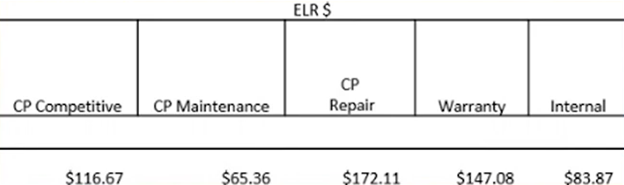
This is fairly typical, as ELR changes by category, which is the reason why we can’t uniformly say what’s our total shop ELR. Instead, we want to get to what the ELR is by labor category so that we can project things more accurately and satisfy that accuracy objective.
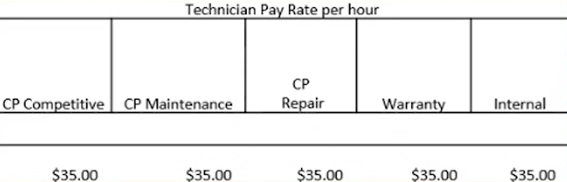
Step 4: Determine Technician Pay Rate by Category
Technicians may be paid different hourly rates, depending on the type of work they do. However, most often the same hourly rate is paid to the technician regardless of labor category, despite some shops where there is variation. If that is the case for your dealership, that needs to be reflected here as well.
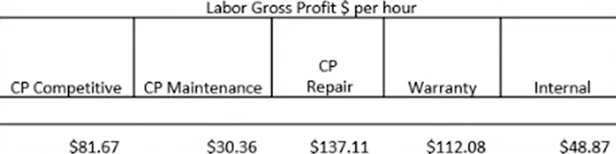
Step 5: Labor Gross Profit per Hour by Category
In step five, we can look at the gross profit dollars per category. If you subtract the ELR from the technician pay rate, you get how much gross comes from every hour depending on the type of work being done.
Step 6: Labor Gross Profit Dollars
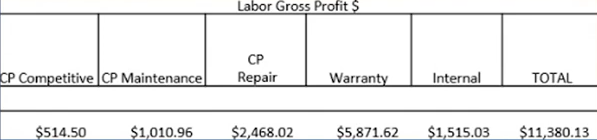
Next, you multiply the labor hours times the labor gross profit per hour. We can now see the gross profit dollars.
Step 7: Labor Gross Profit Percentage
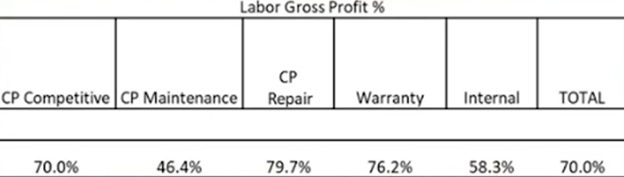
To find the gross profit percentage, take the labor gross profit divided by the labor sales. You’ll see that you generally look at that number for the total shop in the 70 to 75% range.
However, in our example, there is quite a split here. The differences across each labor category point you to opportunities just by looking at that one number.
Step 8: Parts Sales by Category
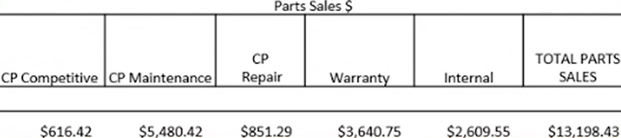
In step 8, we shift from labor to looking at parts.
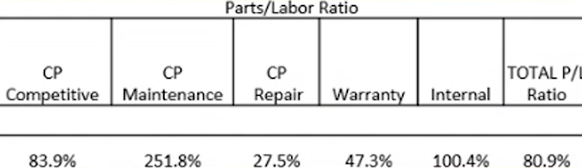
Step 9: Parts to Labor Ratio
Here, we can see that the gross profit or price to labor ratio is often 80 cents to the dollar. This particular example is 80.9%. But, it’s spread out quite differently by labor category. This again reinforces the need to examine each category independently.
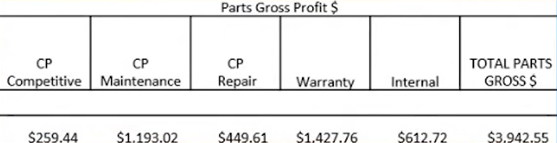
Step 10: Parts Gross Profit
Determine the parts gross profit by subtracting the parts cost from the parts sales.
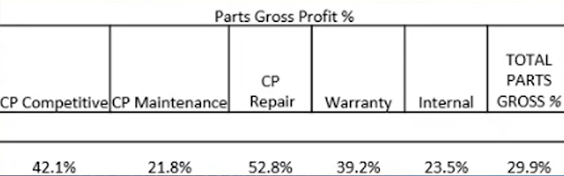
Step 11: Parts Gross Profit Percentage
Divide parts gross profit by parts sales to get your percentage!
Providing Feedback and Coaching
Consistent feedback and coaching help service advisors grow and deliver better customer experiences. Service managers play a critical role by highlighting strengths, identifying improvement opportunities, and reinforcing processes. Additionally, encouraging open communication builds a learning-focused culture where advisors share insights and support one another.
Recognizing and Rewarding Good Performance
Recognition fuels motivation. Celebrate service advisors who exceed expectations—whether through bonuses, promotions, public acknowledgment, or other incentives. Positive reinforcement boosts morale and encourages advisors to maintain high performance.
Best Practices for Measuring Performance
To measure advisor effectiveness, track KPIs such as customer satisfaction, scheduling efficiency, and repair order accuracy. Beyond the numbers, evaluate communication, technical understanding, and problem-solving abilities. Ultimately, clear goals drive accountability and continuous improvement.
Let Dynatron Do the Heavy Lifting for You!
Following these steps for each technician in your Service Department can feel overwhelming, especially on top of your daily workload. That’s where Dynatron comes in. Dynatron’s solutions deliver every data point needed for steps 1-11 available at your fingertips. Our TechCF tool provides a complete baseline performance report for each technician, giving you a framework ready for the next year’s projections.
Ready to get started? Let’s chat!