Setting the right price for your products or services is one of the most critical decisions a business can make. Price too high, and you risk losing customers. Price too low, and you leave money on the table. Sustainable growth requires a data-driven approach, not guesswork. Principles of labor and parts pricing optimization provide a systematic framework to maximize revenue. An optimal price calculator helps businesses identify the price point that drives both sales and profits. This guide explains formulas, strategies, and steps to calculate the perfect price.
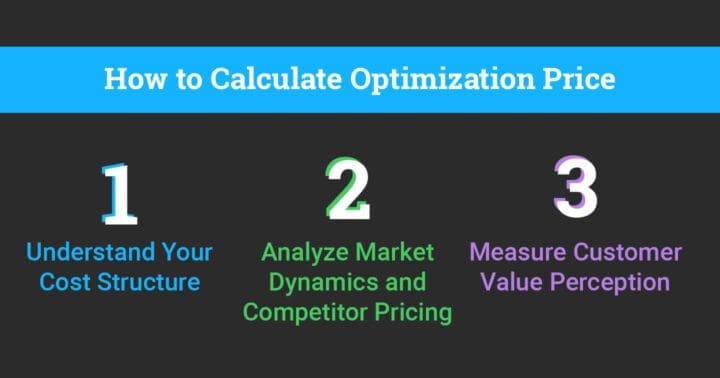
How to Calculate Optimization Price
Calculating the optimization price for a product or service is a multifaceted process that goes far beyond simply covering costs and adding a markup. To achieve optimal profitability, you must take a strategic approach that considers both internal operations and external market factors. Let’s break down this process into manageable, actionable steps.
Step 1: Understand Your Cost Structure
Start by understanding your costs. This means accounting not only for the direct costs of producing your goods or delivering your services (often known as Cost of Goods Sold or COGS), but also for all associated variable and fixed costs. Variable costs, such as raw materials and direct labor, fluctuate with production volume. Meanwhile, fixed costs, like rent, salaries, and insurance, remain constant regardless of output. By accurately mapping these expenses, you determine your break-even point, which is the minimum price required to cover all costs. This figure establishes the essential floor for your pricing strategy.
Step 2: Analyze Market Dynamics and Competitor Pricing
Next, examine competitor pricing and market trends. Analyze how similar products are positioned and priced in the market. Conduct a thorough competitive analysis for essential context, but remember—not all successful pricing comes from imitating competitors. Use this data to define your value proposition and market position. Are you promoting a premium alternative with superior features, or are you offering a budget-friendly solution for value-oriented customers? Your pricing should directly reflect your chosen market positioning.
Step 3: Measure Customer Value Perception
Finally, consider how your customers perceive value. Use surveys, A/B tests, or conjoint analysis to understand what your audience is willing to pay. The ideal price balances profitability and customer expectations. An optimal price calculator helps quantify this balance.
Optimizing Profitability: A Continuous Process
Finding the optimal price isn’t a one-time task—it’s an ongoing process. Continuously analyze sales data, costs, competitor actions, and market demand. The goal is the “sweet spot,” where the combination of sales volume and profit margin maximizes total profit.
Leveraging Data and Lifetime Customer Value
Now, let’s explore how you can put this into practice. Start with price elasticity—how demand changes with price. A/B testing, historical sales analysis, and surveys provide insights into customer sensitivity. Incorporate lifetime customer value (LCV) to understand long-term profitability. A slightly lower price may boost customer retention and overall profit. By combining costs, elasticity, and LCV projections, an optimal price calculator identifies the price that delivers maximum profit.
What is the Optimal Price to be Charged?
Determining the optimal price to charge is a critical strategic decision that directly impacts profitability. To maximize total profit, you must move beyond intuition and employ systematic analysis. Let’s break this process into key components for clarity and efficiency.
Understanding the Optimal Price Formula
At its core, finding the optimal price depends on the relationship between price and quantity sold. While there isn’t a single, universal optimal price formula for every business, the standard approach is:
Profit = (Price – Variable Cost per Unit) × Quantity Sold – Fixed Costs
To use this formula effectively, you need to estimate how many units you’ll sell at different prices. This is where demand modeling comes in.
The Role of Price Elasticity
Price elasticity measures how sensitive your customers are to price changes. If a small price increase triggers a large drop in demand (elastic), the optimal price will be lower. Conversely, if increasing your price leads to little or no change in demand (inelastic), you can sustain a higher price point for greater profit. Gather this data by analyzing historical sales, running market surveys, or conducting price experiments like A/B testing.
Applying Data to Identify Peak Profit
Once you have a reliable understanding of how quantity sold varies by price, you can map your expected profit across various price points. The optimal price is where this profit curve reaches its highest point. For example, you might discover that at $50 per unit, you sell 1,000 units, but at $55, you sell 850 units. Calculating total profit at each level, considering both variable and fixed costs, enables you to identify the price that delivers the highest return.
Ensuring a Deliberate, Profitable Price
By following this data-driven process, you transform pricing from guesswork into a calculated business strategy. Ultimately, this approach ensures you set your prices deliberately, ensuring maximum profitability.
How to Calculate a Good Price
Getting the price right is fundamental for any business. A good price should not only cover all your costs, but also help you earn a healthy profit while appealing to your target customers. Striking this balance between internal goals and market demands builds a solid foundation for growth. Now, let’s walk through the key steps involved in calculating a good price.
Applying the Cost-Plus Pricing Model
The Cost-Plus Pricing Model is a direct way to set your selling price. You start by adding all production and delivery costs—both variable and fixed. Then, you apply a markup, which represents your desired profit. The selling price formula is simple:
Selling Price = Total Cost + Markup
Total cost covers materials, labor, and a share of fixed overhead like rent and salaries, while your markup reflects your profit target on each sale.
For example, if it costs $75 to produce a unit, and your profit margin target is 25%, the markup is $18.75 ($75 × 0.25). Your selling price would then be $93.75 ($75 + $18.75). This approach ensures you recover costs and establish a defensible minimum price for your offering.
Considering Market and Customer Value
An effective pricing strategy should not stop at costs. You should also consider how customers perceive value and what competitors charge for similar products or services. While cost-plus calculations ensure you never sell at a loss, evaluating the market helps determine if your price maximizes profit potential. After setting a cost-based price, assess market rates and test what customers are willing to pay based on the unique benefits your product delivers.
By combining internal cost analysis with external market validation, you ensure your price is both profitable and competitive—and ultimately, one that the market will bear.
How to Determine the Optimal Pricing Strategy
Determining the optimal pricing strategy is a process that transforms pricing from a reactive measure into a proactive driver of profitability. An effective strategy is not built on guesswork, but on a rigorous analysis of market data, cost structures, and customer behavior. It requires a commitment to a data-first methodology to identify and implement price points that maximize financial returns.
Start with Cost Structure and Profit Goals
The first step is a comprehensive analysis of your cost structure and profit goals. You should have a clear understanding of your variable costs per unit and total fixed costs. This data establishes your break-even point and sets the absolute floor for your pricing. From there, define your target profit margin. This initial calculation provides a baseline price range that ensures financial viability for every sale.
Analyze Market Demand and Price Elasticity
Gather data on customer sensitivity to price changes. High elasticity requires careful price increases, while low elasticity allows for higher prices without major demand loss.
Integrate Competitive Intelligence and Value Perception
Finally, integrate competitive intelligence and value perception into your model. Your pricing does not exist in a vacuum. Analyze competitor pricing to understand the market landscape, but don’t simply copy their strategies. Instead, use this information to strategically position your offering. If your product delivers superior value, set your price to reflect that. Quantify the unique benefits provided, and ensure your price aligns with the value delivered. By combining cost analysis, elasticity modeling, and value-based positioning, you create a robust, defensible pricing strategy engineered for maximum profitability.
Determining the optimal price requires a transition from manual calculation to leveraging sophisticated, data-driven tools. While understanding the underlying formulas is essential for strategic oversight, modern technology streamlines the complex analysis needed to pinpoint the most profitable price point. These tools automate the intensive data processing, modeling, and forecasting required for true price optimization.
The most effective way to implement a pricing strategy is through specialized software, like Dynatron’s PriceSmart solution or a dedicated price calculator online. These platforms process vast datasets in real-time, offering a significant advantage over static spreadsheet models. They connect directly to your sales data, inventory levels, and external market intelligence feeds, enabling dynamic and responsive pricing adjustments. Built to analyze customer behavior, identify purchasing patterns, and model demand elasticity, these tools ensure your pricing strategy is precise, data-driven, and profit-maximizing.

How Do You Find the Ideal Price?
Finding the ideal price for a product or service is a systematic process that relies on precise data and analytical tools. An optimal price calculator provides the framework to synthesize complex variables into a single, profit-maximizing figure. Using an optimal price calculator with steps ensures a structured and repeatable methodology, removing conjecture from this critical business function. The process is grounded in a logical progression from cost analysis to market validation.
Step 1: Establish a Comprehensive Cost Basis
This initial step requires inputting all variable costs associated with producing one unit of your product or delivering your service. This includes raw materials, direct labor, and any other expenses that scale directly with volume. Next, you must account for fixed costs, such as rent, salaries, and utilities, by allocating a portion of these expenses to each unit. This provides the total cost per unit, which serves as the price floor. No price can be considered ideal if it fails to cover these fundamental expenses.
Step 2: Model Customer Demand
A robust price calculator requires data on price elasticity to function effectively. You will input data gathered from market research, such as A/B tests or conjoint analysis, which demonstrate how changes in price affect sales volume. By feeding the calculator different price points and their expected sales quantities, the tool begins to build a demand curve specific to your offering.
Step 3: Identify Peak Profitability
Finally, the calculator processes this information to identify the point of maximum profitability. It computes the total profit for each price point by subtracting the total variable costs from the total revenue and then deducting fixed costs. The calculator will then display a range of potential prices alongside their projected profits. The ideal price is the figure that yields the highest absolute profit, representing the perfect balance between attracting sufficient sales volume and maintaining a strong profit margin on each transaction.
Following these steps provides a definitive, data-driven answer to your pricing challenge.
Final Thoughts
Setting the right price is not a matter of chance; it is a calculated business discipline. Throughout this guide, we have established that finding the optimal price requires a strategic shift away from intuition and toward data-driven analysis. From understanding your complete cost structure to modeling demand with price elasticity, each step is critical for building a pricing strategy that delivers sustainable financial results. The use of a structured optimal price formula, supported by robust analytics, transforms pricing from a defensive necessity into a powerful offensive tool for growth.
By leveraging dedicated tools like an optimal price calculator, you can automate this complex analysis and gain the confidence to make pricing decisions that directly enhance your bottom line. This methodical approach ensures that pricing aligns with true market value, competitive positioning, and core profitability goals. It is the definitive path to moving beyond simply covering costs and toward maximizing your revenue potential.
Are you prepared to implement a pricing strategy that drives measurable success? Contact us today to see how a systematic approach to pricing can revolutionize your Fixed Ops profitability.