Dealership Software: Getting the Most Out of Your DMS
Dealership Software: Getting the Most Out of Your DMS
The right dealership software can have a dramatic impact on not only its efficiency and productivity, but the type of customer experience it can deliver as well. The modern dealership is a much more technologically-connected business—from sales and marketing platforms designed to attract and engage prospective customers to CRMs and dealership management systems (DMS) that cultivate better relationships.
Whether you’re just starting to explore these platforms or you’re pretty experienced and trying to gauge if it’s time for an upgrade, you’ll want to keep reading. This article will provide a broad overview of the types of software that dealerships use, and how to evaluate these products to find the best platforms for your dealership.

What Kind of Software Do Car Dealerships Use?
A successful car dealership typically uses several different types of software, including:
- A dealership management system (DMS) provides an essential and comprehensive platform for managing a dealership’s daily operations. The best dealership management software offerings provide wide-ranging feature sets and functionality, including features related to accounting, parts and service management, sales, reporting, and more. Some of the most comprehensive and commonly-used DMS solutions include those provided by Dealertrack, Reynolds and Reynolds, DealerCenter, and CDK Drive.
- A dealership CRM or Customer Relationship Management) platform provides the framework for enhancing customer relationships, building trust, and creating memorable and productive experiences. Dealerships use automotive CRM software to store and process customer data, manage customer communications, and turn their data into actionable insights.
- Vehicle appraisal tools enable dealerships to accurately estimate the value of vehicles on a case-by-case basis, considering factors such as vehicle condition, market data and trends, and more. What program do dealers use to value cars? It depends on the dealership, but the most popular offerings include Kelley Blue Book, Edmunds, and Cars.com.
- True to its name, inventory management software includes a feature set designed to help dealerships track, manage, and optimize their inventory in real-time. The most advanced platforms can automate several of these (and related) processes, helping dealerships to efficiently and effectively track, manage, and stock their inventory.
- Like virtually any business, car dealerships adopt marketing and automation software solutions to attract and engage both new and existing customers. Understanding the importance of reaching the right audience with the right message (and tailoring marketing messages accordingly), these platforms help dealerships to plan, execute, and measure the success of their campaigns. These platforms increasingly leverage AI and automation to tailor and scale their campaigns with great efficiency.
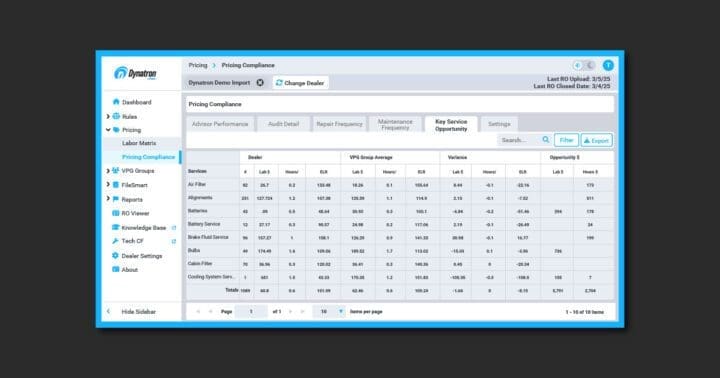
- Finally, dealerships that want to identify hidden revenue opportunities and maximize the profitability of their Fixed Ops also adopt a robust reporting and analytics platform. For example, Dynatron’s solutions replace the tedious and time-consuming process of manually combing through DMS data for actionable insights with offerings that leverage analytics software, business intelligence, industry experience, and coaching to identify your revenue opportunities, create an action plan, and capture additional revenue.
Data is only as valuable as it is useful, and yet dealerships often face challenges when it comes to uncovering meaningful insights. Next, let’s explore how dealerships can make the most of one of their central technologies—the dealer management system.
What is a Dealer Management System?
As noted above, a dealer (or dealership) management system refers to a specific type of dealership software that provides a foundation for managing the dealership’s daily business and operations. In many ways, a dealership’s DMS serves as a unified, “single source of truth” that keeps various business units—including sales, finance, and customer service—aligned and productive.
What Does a Dealer Management System Do?
A dealer management system integrates a suite of tools designed to streamline dealership operations, ensuring they run efficiently, seamlessly, and effectively. The best DMS software for auto dealers provides a wide range of features and functionality, including tools for sales, inventory management, and service management.
Adopting the right DMS platform makes it easier for dealerships to perform daily functions across different departments including sales, Fixed Operations, and more. Further, the best dealer management software includes a comprehensive feature set that’s ready to scale and evolve as needed, in order to achieve dealership-specific objectives/priorities.
It’s important to note that not all auto dealership software is created equally, making it important to evaluate different applications’ features and benefits, as well as the dealer management system companies behind these platforms. The best auto dealership software companies provide more than just a software platform for centralizing and streamlining operations; they can also unlock new ways of delivering efficient service and growing the business.
While many DMS platforms are offered as standalone products, they typically support a range of custom integrations—meaning the adoption of a new DMS platform doesn’t necessarily mean a dealership has to rethink every piece of software they use (to ensure compatibility).
What is the Best Automotive DMS?
It really depends on what your priorities are. While comparing features lists can sometimes prove difficult, there are several reliable ways to evaluate DMS solutions—and the dealer management software companies behind them. For example, you might compare them on the basis of their:
- Core, out-of-the-box functionality for sales and service management, inventory management, accounting and finance, and more.
- Ability to seamlessly integrate with other dealership software systems, such as your CRM or bookkeeping software.
- Intuitiveness and ease of use for employees, without requiring extensive training.
- Customization and scalability, meaning how well the technology will serve the dealership’s current—as well as future—needs.
- A pricing and cost structure that makes sense and aligns with the value provided by the software platform.
Ultimately, the best automotive DMS is the one that offers the features, customization, and scalability your dealership needs to operate smoothly. When comparing platforms, don’t focus solely on their core features or capabilities. It’s important to remember that no two dealer management system providers are alike. Take the time to research the companies behind the products to make a well-informed decision. By prioritizing companies with a reputation for developing great products and services, offering timely support, and communicating effectively with customers.
What is an Automotive Dealer Management System Used For?
An automotive dealer management system is meant to coordinate, streamline, and unify operations across a dealership’s various departments. This approach—consolidating existing tools—provides a more cost-efficient solution, and one that’s easier to configure and maintain than piecemeal solutions.
To get a better idea of these application’s versatility, consider the most common dealer management system features, which enable dealerships to:
- Integrate their accounting software with their DMS, keeping payment data secure and customer payment histories organized, among other features.
- View, monitor, and manage existing inventory, making it easier to maintain the ideal inventory based on demand.
- Configure retail and point-of-sale (POS) systems to integrate with other software solutions.
- Leverage advanced analytics to create, manage, and share a wide range of customized reports.
- Optimize the customer experience and build deeper, more productive relationships by adopting (and integrating) a feature-rich CRM platform that keeps customer details organized, up-to-date, and accessible.
- Track productivity and improve efficiency through features for scheduling and managing service appointments—and keeping customers informed and up-to-date.
- Provide customers with timely and accurate repair orders and billing estimates, with all transaction data synced with the dealership’s CRM (and other software, as needed).
- Generate and nurture leads, including customizable price quoting and deal structuring.
Of course, each DMS on the market offers its own advantages and potential drawbacks, underscoring the importance of carefully evaluating these platforms and the auto dealership software companies behind them. As you evaluate their offerings, then, it’s important to also gauge how well these companies listen to your needs and optimize configurations accordingly.
This is one area where a reporting and analytics platform like Dynatron stands out from its competitors, offering not only the tools you need to increase efficiency and revenue, but the custom-tailored coaching required to truly optimize the software in a way that benefits your dealership and your customers.

How Does a DMS Work?
A DMS provides a versatile and balanced set of features that, when properly implemented, unite the various departments and offers a “single source of truth.” If it helps, you can also think of a DMS as the engine that drives dealership operations, enhances the customer experience, and unlocks new levels of efficiency, productivity, and profitability. In addition to its core functions and features, most also include a wide range of options for customization, reporting, and more.
As you narrow your options down to a manageable number, it never hurts to reach out and schedule demos with these providers. That way, they can show you what implementation might look like for your dealership—and you can get a better idea of each company’s responsiveness and ability to cater to your personalized needs.
What are the Benefits of a DMS?
Leveraging the right software provides dealerships with countless benefits, including the ability to:
- Maximize Efficiency: One of the biggest benefits of modern DMS solutions is their ability to maximize efficiency by integrating with existing tools and automating routine tasks like sales tracking, customer follow-ups, and inventory updates.
- Elevate the Customer Experience: Customers across virtually every industry increasingly expect efficient and personalized service at each touch point. Using a DMS that integrates with a dealership CRM makes customer data, including their preferences and transaction histories, easily accessible—so employees always know who they’re talking to and how to best serve them.
- Increase Profitability: When dealerships can maximize efficiency and elevate the customer experience (see the two points above), it can have a significant, positive impact on potential profitability. It can also inspire customer loyalty—through improved response times and fewer errors, for example.
- Improve Inventory Management Processes: While inventory management doesn’t get as much attention as one of a DMS’s core benefits as overall efficiency and productivity, it plays an important role at any dealership, for better or worse. Choosing the right DMS can help mitigate some of the inventory management challenges dealerships face, like over- or under-stocking, inventory loss, poor visibility, and data entry errors. It’s worth noting that reliable and effective inventory management processes are especially important for dealerships with multiple locations.
- Streamline Operations and Consolidate Vendors: One of the biggest benefits of choosing a comprehensive and customizable DMS is the ability to consolidate features and services—as well as vendors. Typically, the fewer platforms (and vendors) the better, as a matter of convenience, efficiency, cost reduction, and even security.
- Optimize Sales Processes: A dealership’s growth often depends on the ability to effectively leverage data and insights to generate leads, track sales, and deepen its ability to understand—and accommodate—each customer’s unique needs and preferences. When a dealership’s CRM seamlessly integrates with its chosen DMS, it provides sales teams with the data and insights they need to connect with each customer, build trust, and deliver value.
- Maintain Regulatory Compliance: Leveraging a DMS enables dealerships to keep their financial data as accurate, up-to-date, and compliant as possible. In the past, meeting these requirements meant seemingly never-ending manual processes—but modern DMS platforms make aspects of financial record-keeping and regulatory compliance a relative breeze through automation.
- Access Actionable Insights: Virtually every modern business or industry benefits from data-driven decision making—including dealerships. You can’t improve what you’re not measuring, so data and insights are key to nearly every aspect of dealership operations, including driving sales, maintaining inventory levels, developing customer relationships, and more. A platform like Dynatron not only helps dealerships to significantly increase the efficiency and profitability of their Fixed Ops, it’s the only product of its kind to offer a 3:1 ROI guarantee.
- Customize and Scale: In the earliest days of dealership software, a one-size-fits-all approach was the only available. Today’s solutions, by contrast, differentiate themselves in a wide range of ways, underscoring the importance of doing your research when evaluating your options. Two of the most important considerations include customization and scalability. With a customizable platform, you can more effectively understand and meet your customers’ expectations—and its scalability means it can evolve alongside your growing business.
- Integrate Seamlessly with Other Platforms: Adopting and implementing the best dealership software for your needs is just one component of the equation for running a successful dealership. The other side relates to how well those solutions work together to create new efficiencies and maximize their benefits of each platform they choose. At a minimum, the DMS you choose should integrate seamlessly with your CRM, marketing, and sales platforms. That way, all employees and departments can provide a consistent customer experience across each and every touch point.
What Should I Look For in Dealership Management Software?
Choosing the right DMS can directly impact the dealership’s ability to attract, engage, and retain customers while streamlining its own operations and efficiency. While each dealership inevitably has its own priorities and preferences, there are several key considerations that underscore the importance of adopting a solution that aligns with your unique needs.
It can sometimes be difficult to compare one platform or provider to another, leaving many decision-makers trying to evaluate different features lists and value propositions. With that being said, it’s helpful to consider the following factors when researching your options:
- Comprehensive vehicle inventory management features, including real-time visibility into not just what vehicles are in stock, but detailed vehicle specifications, pricing information, and more. Some DMS platforms even include the ability to automatically reorder when certain inventories are low.
- Integration with your preferred CRM to store and organize customer details and transaction histories, making them available for anyone who might need them in dealing with customers or generating reports.
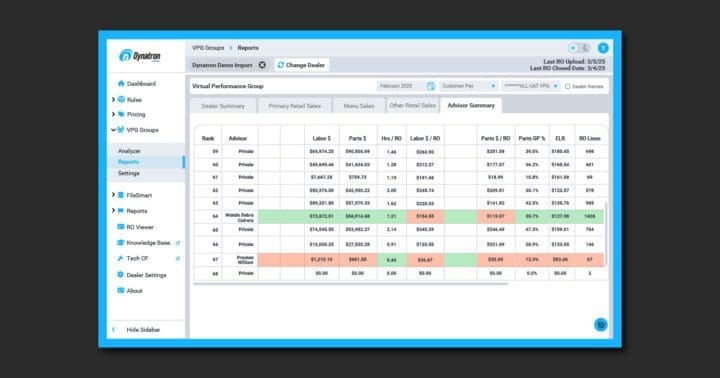
- Robust reporting and analytics features to transform data into actionable insights, including the creation of customized dashboards. Depending on the priorities of the dealership, these features can be used to better understand and influence sales performance, improve service metrics, and track key business indicators.
- Accounting and financial management tools that enhance a dealership’s ability to effectively manage transactions, coordinate and process payments, and develop detailed business performance reports.
- A parts inventory tracking system that makes it easier to know when it’s necessary to restock, ensuring that customers never have to wait for the dealership to order additional inventory. In many cases, a DMS will also include features for tracking and managing part-specific warranties.
- Service scheduling and appointment management features, or the ability to integrate your DMS with a Fixed Ops partner like Dynatron for increased efficiency and profitability. All too often, dealerships leave key revenue opportunities on the table because they don’t have effective frameworks to overcome common service department challenges, like:– Lacking the internal expertise/support to identify, diagnose, and remedy inefficiencies.– Devoting too much time and energy to manual processes for effective forecasting, planning, and optimizing operations.
– Not having effective technology in place for understanding how service department inefficiencies can impact other departments and reduce overall Fixed Ops profitability.
- Coordination across multiple locations, ensuring that all parties can access the insights and tools they need to manage customer relationships and provide exceptional service. This often includes mobile accessibility as well—so folks who might be out selling, for example, can also have the information right at their fingertips.
- Customization and scalability capabilities, to extend these systems’ functionality to meet the needs of the dealership—not just at the onset or adoption of the software, but over the course of the weeks and months to follow, as well. With the right DMS solution, it’s easy to customize its core features and scale its usage as your dealership grows—or its needs become more complex.
- Customer service and support, so if anything goes wrong, it’s easy to reach the company, either directly or through a self-service portal, and make sure everything is working properly. While this point might not be as “flashy” as some of the other features in this list, it’s something that DMS companies often prioritize as a differentiator. When in doubt, you can do a little research online to determine which companies have the best reputation for service and support.
It’s difficult to overstate the importance of not only finding the best DMS for your dealership, but getting the most out of it as well. In other words, it doesn’t matter if you have all the data in the world if that data’s not easily accessible. Dynatron’s solutions enable you to more effectively leverage your dealership’s data, turning it into actionable insights you can leverage for more informed decision-making, optimized operations, and increased customer satisfaction—all while driving growth and maintaining compliance.
Next, let’s explore one specific best practice for maximizing the value of your DMS data—using custom integrations to streamline operations and extend DMS (and other platforms’) functionality to benefit your dealership.
What are DMS Integrations, and Why Do They Matter?
Integrated with other dealership technologies—like a CRM or marketing platform—Dynatron’s analytics-focused solutions can maximize dealership revenue and Fixed Ops profitability. We offer a collection of integration-ready offerings designed to make complex DMS data easily digestible, including:
- PriceSmart: PriceSmart is all about Fixed Ops price optimization, and dealerships use it to identify optimal service pricing that’s neither too high (in which case customers might take their business elsewhere) nor too low (threatening profitability). PriceSmart enables dealerships to maximize both profit and retention—a win-win!
- FileSmart: Keeping up with state law changes and cumbersome filing requirements is time-consuming, and can require seemingly endless attention. FileSmart is a warranty rate solution that leverages decades of industry experience and expertise to identify the best RO sample data—so dealerships can increase their approval rate and maximize their labor and parts increase.
- MarketSmart: For many dealerships, marketing almost feels like an afterthought. MarketSmart, however, enables dealerships to execute campaigns based on data, not instinct. MarketSmart is a solution that can analyze your Service Department data to create customized marketing campaigns to target new and/or existing customers across one or multiple channels.
Unlock Greater Insights with Dynatron’s Fixed Ops Analytics Platform
Virtually every Service Department has room for improvement, and Dynatron’s software suite can play a key role in increasing the efficiency and effectiveness of Fixed Ops. Benefits of these solutions include the increased ability to…
- Generate Revenue and Increase Profitability: Using Dynatron, you gain access to intuitive reporting tools that can unlock valuable insights to improve Fixed Ops profitability, as well as industry expert coaches to guide its implementation.
- Improve the Customer Experience, Increasing Retention: While many dealerships focus on attracting new customers, it’s also important to keep your existing customers happy—otherwise they may defect to a competitor. Using Dynatron’s solutions, dealerships can more efficiently process customer data and translate it into actionable insights for improving the customer experience at each touchpoint, including the Service Department.
- Maintain Smooth Daily Operations and Maximize Productivity: By providing Service Managers and Advisors with daily, customizable reports into technician performance, overall service drive health, and more.
- Perform Repairs Effectively and Efficiently: Creating a positive customer experience starts with an accurate quote and extends across every touchpoint—including Fixed Operations. Dynatron removes much of the guesswork and mystique around service quotes by helping to identify the ideal price point for various services. In turn, the dealership can remain competitive, increase its profitability, and build customer loyalty over time.
- Improve the Efficiency of Warranty Filing Protocol: Starting with repair order data from its DMS, Dynatron enables a more time- and cost-effective approach by identifying the best set of ROs to send for a warranty repair.
Get the Most Out of Your DMS with Dynatron
Dynatron Software provides a collection of cloud-based applications that integrate with several of the most popular DMS solutions (including Dealertrack, Reynolds & Reynolds, CDK Global, and more) to identify hidden revenue opportunities and deliver an outstanding ROI.
If you’re ready to move on from outdated or piecemeal solutions and increase your Service Department’s efficiency and profitability, Dynatron is ready to help! To see how Dynatron can transform your dealership’s Fixed Ops, don’t hesitate to schedule a demo with our expert team today!